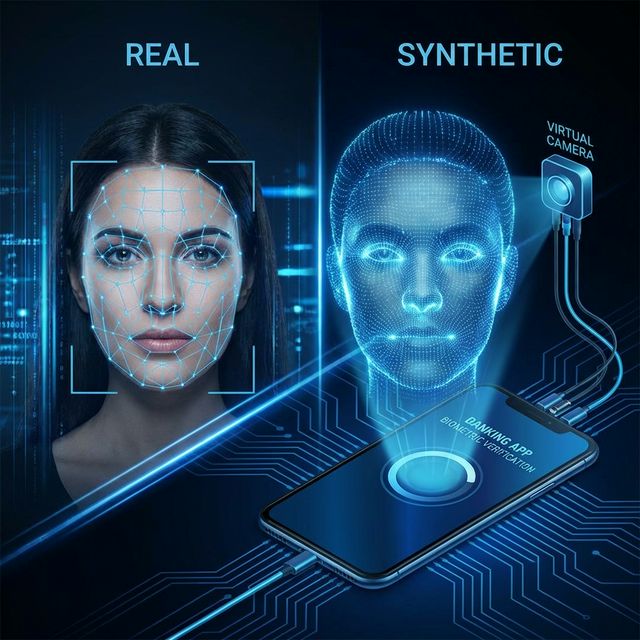
Identity fraud in Latin America and the Caribbean surged by 137% in 2024, driven largely by one devastating innovation: the use of virtual camera software to inject stolen or AI-generated video feeds into banking applications during biometric verification. This technique is rendering traditional facial recognition systems dangerously obsolete.
Understanding the Virtual Camera Attack
A virtual camera (vCam) is a software application that creates a emulated camera device on a smartphone or computer. Originally designed for legitimate purposes—such as video conferencing filters or screen sharing—this technology has been weaponized by fraudsters to bypass biometric identity verification.
The attack vector is deceptively simple:
- Acquire biometric data: The attacker obtains a photo or short video of the target victim—often from social media profiles, data breaches, or even by purchasing identity documents on the dark web.
- Generate a deepfake: Using AI-powered face-swapping tools, the attacker creates a realistic video of the victim performing the required liveness actions (blinking, turning the head, smiling). These tools are increasingly accessible and affordable, available on both the dark web and public platforms.
- Inject via virtual camera: The deepfake video is fed through virtual camera software, which presents it to the banking app as if it were coming from the device's real camera. The app's biometric system processes it as a legitimate live capture.
- Bypass verification: If the liveness detection is not sophisticated enough to detect the injection, the attacker gains access to the victim's account or creates a new fraudulent account using the victim's identity.
The Evolution of the Threat
What makes this attack particularly dangerous is how rapidly it has evolved:
- First generation (2022-2023): Attackers used printed photos or static images held up to the camera. These were relatively easy to detect with basic liveness checks.
- Second generation (2023-2024): Pre-recorded replay attacks using video playback on a secondary screen. More effective, but still detectable through screen texture analysis.
- Third generation (2024-present): Native virtual cameras that operate within standard device permissions—no root or jailbreak required. These create video streams that are virtually indistinguishable from real camera feeds at the operating system level, with a 2,665% increase in detection globally in 2024.
Why Latin America Is Ground Zero
The convergence of several factors makes the region particularly susceptible:
- Rapid biometric adoption without proportional security: Banks and fintechs across the region have aggressively adopted facial verification for account opening and transaction authorization, but many rely on basic liveness detection that was designed for earlier, simpler attack vectors.
- Thriving dark web marketplace: Criminal communities are actively marketing specialized deepfake tools designed to bypass Latin American financial institutions' specific biometric systems. Packages are sold for as little as $20 USD per identity.
- Social media data abundance: High social media penetration rates (73% in the region) provide attackers with an extensive library of facial data to fuel their deepfake generators.
- Regulatory lag: While financial regulators are beginning to address biometric security standards, comprehensive frameworks remain in early stages across most countries.
The Financial Impact
The consequences for financial institutions are severe and multi-dimensional:
- Direct fraud losses: Unauthorized account access and fraudulent account creation lead to immediate financial losses.
- Regulatory penalties: Failure to implement adequate identity verification exposes institutions to regulatory action.
- Reputational damage: Public incidents of biometric bypass erode customer trust in an institution's digital channels.
- Compliance costs: Remediation after a successful attack—including customer notification, account recovery, and system upgrades—can be significantly more expensive than proactive prevention.
Defense Strategies: A Multi-Layered Approach
Protecting against virtual camera and deepfake attacks requires going far beyond traditional biometric verification:
- Injection attack detection: Deploy technology that can detect when a video feed is being injected through a virtual camera rather than captured by the device's native hardware camera. This includes analyzing video stream metadata, frame consistency, and device sensor correlation.
- Advanced liveness detection: Implement multi-frame, AI-driven liveness analysis that evaluates natural micro-expressions, light reflection patterns, skin texture at the pixel level, and 3D depth mapping—features that current deepfake generators struggle to replicate convincingly.
- Device integrity verification: Before initiating biometric capture, verify that the device has not been compromised: check for virtual camera applications, rooted/jailbroken status, debugger presence, and screen recording tools.
- Behavioral layer: Combine biometric verification with behavioral signals—device handling patterns, interaction timing, navigation behavior—to create a holistic identity confidence score that is much harder to spoof.
- Continuous monitoring: Don't treat identity verification as a one-time gate. Implement continuous session monitoring that re-evaluates identity confidence throughout the user's interaction with the application.
Conclusion
The virtual camera and deepfake threat represents a paradigm shift in identity fraud. The attackers have effectively industrialized the ability to impersonate anyone with a publicly available photo. For financial institutions in Latin America, the message is clear: biometric verification alone is no longer sufficient. Only a multi-layered approach—combining injection detection, advanced liveness analysis, device intelligence, and behavioral biometrics—can stay ahead of this rapidly evolving threat.
The window to act is closing. As deepfake tools become more accessible and virtual camera technology more sophisticated, every month of delay makes the problem exponentially harder—and more expensive—to solve.