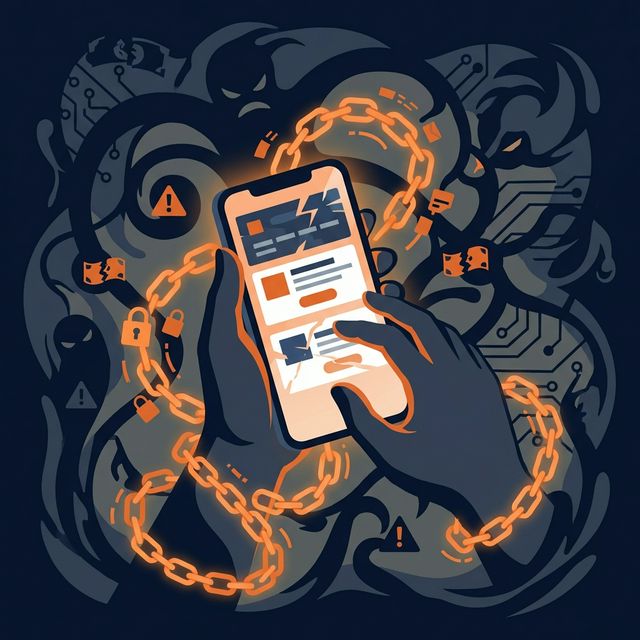
Mexico alone blocks over 1,000 daily attempts from predatory lending applications—a figure four times higher than Brazil and twelve times greater than Colombia. Known locally as "montadeudas" (debt stackers), these fraudulent platforms have become one of the most pervasive digital threats facing consumers across Latin America.
How the "Montadeudas" Scheme Works
The fraud follows a carefully orchestrated two-phase model designed to exploit financial desperation:
Phase 1: The Trap
Victims encounter what appears to be a legitimate lending app—often with convincing branding, user reviews, and professional-looking interfaces. These apps are primarily distributed through official app stores (both Android and iOS), making them appear trustworthy. Upon installation, the app requests extensive permissions that go far beyond what a lending platform would need:
- Full access to contacts
- Photo and media library access
- SMS reading capabilities
- Camera access
- Location tracking
Users, desperate for quick credit, grant these permissions without understanding their implications. A small loan—typically between $50 and $300 USD equivalent—is disbursed almost instantly, creating a false sense of legitimacy.
Phase 2: The Extortion
Within days, the true nature of the scheme emerges. Interest rates ranging from 200% to 3,000% annualized are applied. When victims inevitably struggle to pay, the harassment begins:
- Mass contact notification: The fraudsters use the stolen contact list to send threatening messages to the victim's family, friends, and colleagues, claiming the victim owes money and branding them as a thief.
- Photo manipulation: Attackers download the victim's personal photos and create manipulated images—sometimes of a sexual nature—which they threaten to distribute.
- Device lockout: Secondary malware is deployed that can partially or fully lock the victim's device until additional payments are made.
- Escalation to physical threats: When digital coercion fails, criminal networks—often with local collaborators—may escalate to in-person intimidation, visiting the victim's home or workplace.
A Transnational Criminal Enterprise
Investigations by cybersecurity researchers and law enforcement agencies across the region have revealed that the majority of these operations originate in Asia—primarily Thailand and China—but are carefully localized for Latin American markets. Criminal organizations recruit local partners for collections, translations, and in some cases, physical intimidation.
In Mexico City alone, authorities have disrupted multiple montadeudas operations, discovering that several were coordinated from overseas. The transnational nature of these crimes creates significant jurisdictional challenges for prosecution.
The Human Cost
The social impact extends far beyond financial loss. Victims have reported severe psychological distress, social isolation, job loss, and family breakdown. In several documented cases across the region, the relentless harassment has tragically led to suicide.
Particularly vulnerable populations include:
- The unbanked and underbanked: Individuals excluded from the formal financial system who see these apps as their only option for emergency credit.
- Small business owners: Entrepreneurs facing cash flow gaps who turn to quick lending solutions.
- Young adults: Users with limited financial literacy and high smartphone dependency.
What the Industry Must Do
Combating the montadeudas crisis requires a coordinated, multi-stakeholder approach:
- App store gatekeeping: Stricter vetting processes for financial apps, including verification of lending licenses and regulatory compliance before approval.
- Device-level protection: Mobile security solutions that detect and block apps requesting excessive permissions or exhibiting predatory behavior patterns.
- Identity verification for lenders: Requiring robust KYC (Know Your Customer) processes for any entity offering consumer lending through digital channels.
- Consumer education: Financial literacy campaigns focused on recognizing predatory lending practices and understanding app permission risks.
- Regulatory frameworks: Updated legislation that specifically addresses digital lending fraud, with mechanisms for rapid app removal and cross-border enforcement cooperation.
Conclusion
The montadeudas phenomenon is not just a cybercrime issue—it is a public health and financial inclusion crisis. As Latin America continues to digitize its financial services, the industry must prioritize protecting the most vulnerable users from these predatory schemes. Robust identity verification, device intelligence, and behavioral analytics are not optional—they are essential components of a responsible digital lending ecosystem.